Fuel Prices in France in 2025: Gasoline and Diesel Between Costs and Taxes
10 min read
The price of gasoline or depends on many factors. These include the price of , refining, transportation, and distribution costs, government taxes, oil company margins, and finally the price of any added. In France, taxes will account for around 50% of pump prices in 2025.

© TotalEnergies
Why doesn’t the price at the pump always follow crude oil prices?
Since the 20th century, crude oil prices can fluctuate rapidly depending on supply and demand and certain geopolitical and economic events.
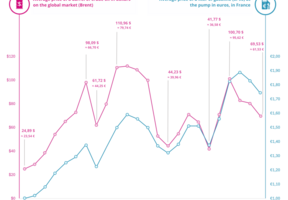
However, the price at the pump does not fluctuate in the same way as the price of a of crude oil. For example, during the global economic crisis of 2007-2008, the price of a barrel of crude oil skyrocketed by 50% between January and July 2008. Over the same period, pump prices in France rose by only 19% for diesel and 11% for unleaded gasoline. Conversely, from June 2014 to June 2016, the price of crude fell by 55%, while diesel fell by only 10% and gasoline by 15%. Crude oil and prices rose at the start of the war in Ukraine, with pump prices in France exceeding the symbolic threshold of €2 per liter.
Three factors explaining the gap between crude oil prices and pump prices
The discrepancy can be explained by three main factors:
• The retail price at the pump includes taxes, which are high in France, Germany, and the United Kingdom, but much lower in the United States. In France in particular, taxes will account for around 50% of the price of fuel in 2025. Taxes are not of course, dependent on fluctuations in crude oil prices. They have increased in France since 2014, while the price per barrel has fallen.
• The prices of a barrel of crude oil and refined products (gasoline and diesel in particular) are set on separate international markets, which obey their own laws of supply and demand. Thus, fuel prices may rise during the summer holidays because demand is higher, while the price of crude oil remains stable.
• In Europe, the crude oil and petroleum product markets use different currencies: the price of a barrel of crude oil is expressed in US dollars, while the price of fuel is expressed in euros. Fluctuations in the value of these two currencies affect the retail price of fuel, regardless of the price of crude oil.
The possible addition of biofuels also tends to push up the overall price, because their production cost is often higher than that of crude oil.
The impact of taxes on fuel prices in France
There are two main taxes:
• the Domestic Consumption Tax on Energy Products (TICPE, formerly known as TIPP), set by the Finance Act.
• VAT at 20%, which is applied to the cost of the refined product and to the , representing in the latter case a “tax on tax.”
Two points are worth noting:
• In 2014, the government incorporated a “carbon” component into the TICPE, based on the carbon tax. At the end of 2018, the decision to increase the carbon tax triggered the “yellow vest” movement. The tax will remain frozen at €44.60 per ton of , whereas it was supposed to reach €100 in 2030.
• To reduce diesel engine use, the government decided to bring the TICPE for gasoline closer to that for diesel. In 2025, the prices per liter of these two fuels are now very similar.
How is the price of one liter of gasoline or diesel broken down?
The breakdown of costs for a liter of gasoline (SP95) or diesel varies, depending on the average price at the pump at a given time.
In November 2025, for a liter of SP95 at €1.76, the breakdown was as follows (source: Rool Data in french):
| Breakdown cost SP95 | In % |
| Production (crude and refining) | 36.1% |
| TICP | 35.2% |
| VAT | 16.7% |
| Transport-distribution | 12% |
In November 2025, for a liter of diesel at €1.72, the breakdown was as follows (source: Rool Data in french):
| Breakdown of diesel cost | In % |
| Production (crude and refining) | 39.4% |
| TICP | 32.4% |
| VAT | 11.6% |
| Transport-distribution | 11.6% |
Overall, in 2025, gasoline and diesel prices in France are higher than in Spain, Belgium, or Sweden, similar to Germany and Italy, and lower than in the Netherlands or Denmark.
 This may interest you
See all