The Extraction of Hydrocarbon Resources
10 min read
After the different exploration phases, new studies are carried out to determine the long-term profitability of the field, the number and type of wells required, and the most suitable facilities. Extraction then begins, either through natural or by using enhanced recovery techniques.

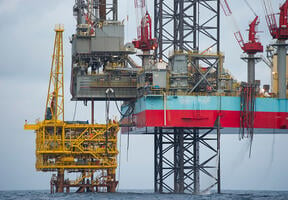
© GONZALEZ THIERRY - TotalEnergies - Hydrocarbons can be located thousands of kilometers underground. Here, gas is produced from a depth of 6,000 meters under the Andes in Incahausi, Bolivia.
How Are Production Wells Drilled: Vertical or Horizontal?
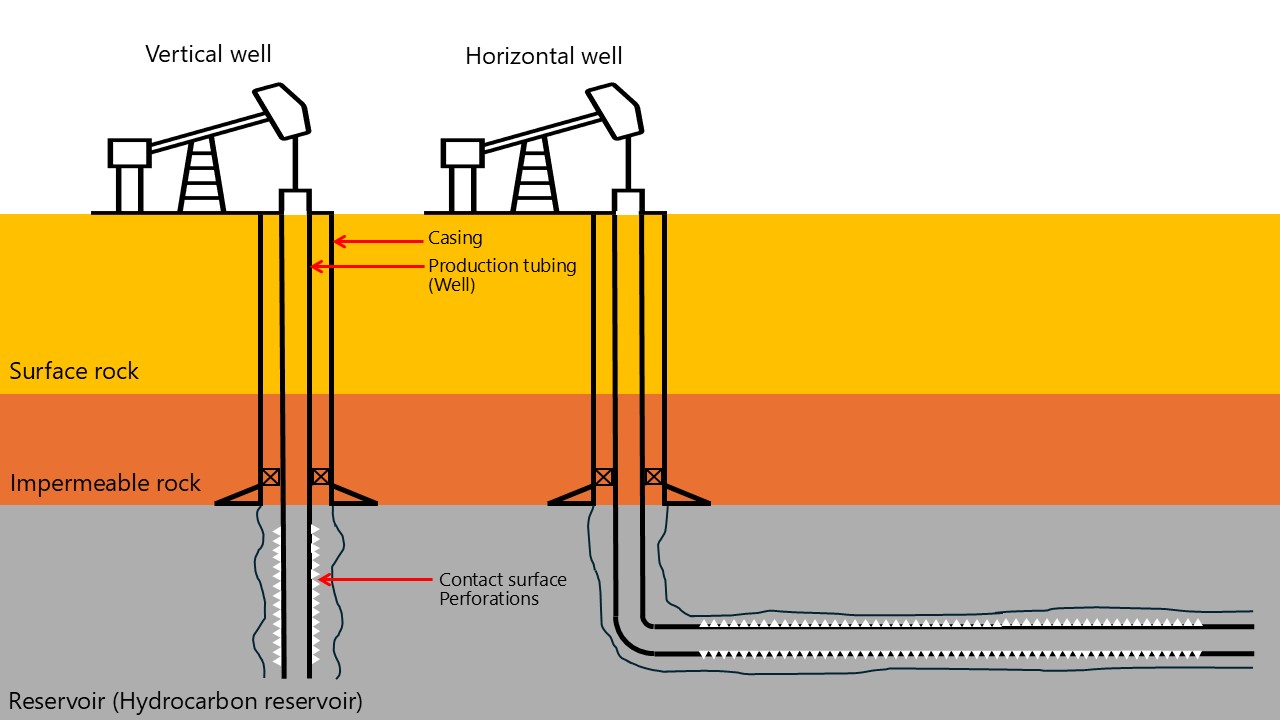
Hydrocarbon reservoirs can extend over very large areas, ranging from a few square kilometers to more than 100 square kilometers. To produce these underground resources, engineers drill wells using different configurations. There are two main categories: traditional vertical wells and horizontal wells.
- Vertical wells have existed since the 19th century. As the name suggests, they are drilled straight down, directly above the reservoir. Their contact surface (the perforations) with the reservoir is limited: it corresponds only to the thickness of the bearing layer, usually a few dozen meters. To extract all the resources from a reservoir, several vertical wells must therefore be drilled.
- Horizontal wells use more recent and more complex techniques. After being drilled vertically, the well gradually curves and then continues horizontally within the reservoir. This configuration provides a larger contact surface with the formation. As a result, fewer wells are needed to exploit the same reservoir. Oil companies therefore, prefer this solution whenever the geometry, depth and location of the reservoir allow it. This is one of the reasons why horizontal wells are now widely favored when technically feasible.
Whatever the type of well, each one is reinforced with a permanent steel . Inside this casing is a production tube, which can be replaced if it becomes clogged (a blocked production tube) or corroded (a perforated production tube).
Once the wells have been drilled and secured, the next step is to determine how the hydrocarbons will be brought to the surface.
How Do Hydrocarbons Rise to the Surface: Naturally or With Assistance?
For hydrocarbons to reach the surface, the pressure inside the reservoir must be high enough to push them upward. Depending on the reservoir’s characteristics, two situations can occur:
- Natural recovery: When the reservoir pressure is sufficiently high, hydrocarbons naturally move toward the well and rise on their own to the surface. This is known as an eruptive reservoir and production by natural depletion (or “natural drainage”).
- Assisted recovery: If the reservoir pressure becomes too low or if the oil is too viscous (or “heavy”) to flow easily, assistance techniques are used. There are two main methods: and fluid .
Two main categories of solutions exist to help a reservoir continue producing: artificial lift and fluid injection.
- Artificial lift uses different systems. Beam pumps (recognizable by their surface rocking beam, also called a “horsehead pump”) drive a piston located at the bottom of the well through an up and down motion. Another solution is to install electric submersible pumps (ESPs) directly at the bottom of the well, just above the perforations: these submerged pumps push the oil up to the surface. Gas can also be injected into the well through the casing to help lift the hydrocarbons to the surface—this is the gas lift process (or gas assisted lift).
- Fluid injection (water or gas) into the reservoir helps maintain and/or increase its pressure, pushing hydrocarbons toward the perforations. For very viscous oils, injecting steam or specific chemical solvents reduces the oil’s viscosity and improves its mobility both near the perforations and inside the production tubing.
What Are the Water Requirements During Hydrocarbon Production?
In oil fields that use water injection as an enhanced recovery method, it is generally estimated that 1 to 3 barrels of water must be injected into the reservoir to produce 1
of oil.
Oil reservoirs can contain varying amounts of water depending on their geological characteristics. This water, naturally mixed with the oil, is called “produced water.” During extraction operations, it is separated from the oil and can be reinjected into the reservoir through dedicated injection wells to maintain adequate pressure and facilitate hydrocarbon extraction.
If is not possible, produced water is treated and filtered before being released back into the environment. Ecotoxicological tests are conducted to ensure that its composition meets regulatory limits in order to protect the ecosystem.
Injection water can also come from different sources, such as:
- Seawater, especially in offshore operations. But not only : for example, in Saudi Arabia, about 10⁶ m³/day of seawater are treated and transported over 300–400 km to be injected into the Ghawar oil field;
- River and estuarine water;
- water, as well as domestic and industrial wastewater.
These different techniques allow production to be adapted to each reservoir, optimize output, and extend the reservoir’s lifespan.
 This may interest you
See all