How Oil and Gasoline Prices are Formed: An Economic Analysis
5 min read
The price of gasoline does not depend solely on the price of a of . Taxes, exchange rates, refining and distribution costs all influence prices. The two price curves (gasoline and crude oil) follow the same long-term trends, but increases and decreases are not necessarily of the same magnitude and do not occur at the same time. Why does the price at the pump change more slowly than the price of oil? Why can fuel such as SP95 remain high even when crude oil prices fall? Understanding these mechanisms helps us understand to address key concepts in economics and social sciences such as price formation, demand elasticity, and the role of taxes in stabilizing markets.
Price trends: How the Oil Market Influences the Gasoline Market
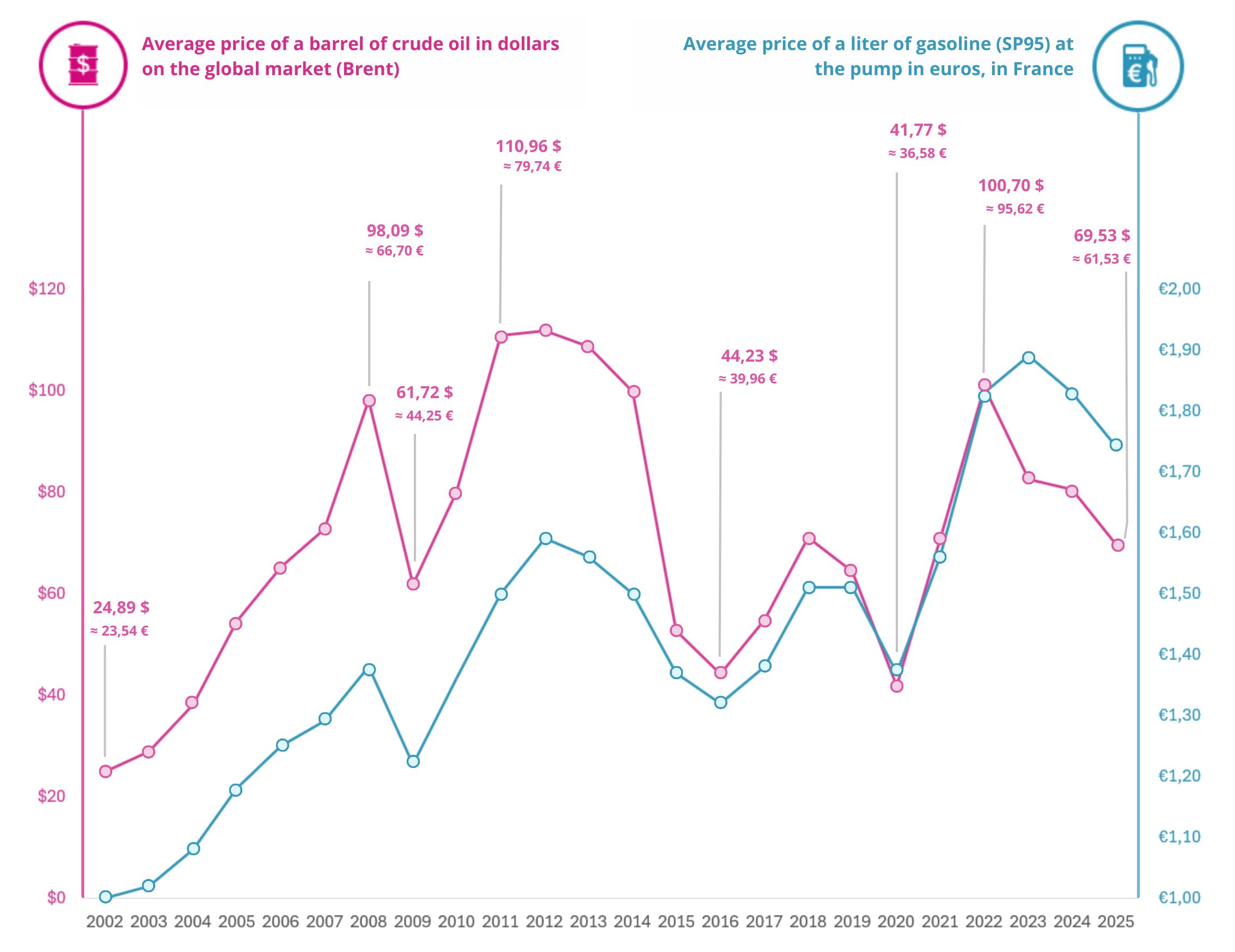
Over a long period (2002–2025), there is a positive correlation between and SP95: when the price of oil rises, gasoline tends to rise as well. This can be explained by the production chain: gasoline is derived from refining of crude oil, so its cost depends on the price of crude oil. However, SP95 is less volatile: it does not fluctuate as sharply as oil.
Why Prices React Differently: Delays, Costs, and Market Structure
Brent reached its peak in 2012 (≈$112/bbl), while SP95 reached its record high later, in 2023 (€1.89/L). This lag illustrates several economic factors:
- the production chain and lead times: between the purchase of oil, refining, transport, and distribution, the final price does not instantly reflect changes in Brent;
- the €/$ exchange rate: oil is paid for in dollars, so if the euro is weak, fuel becomes more expensive for European countries even if the price per barrel remains unchanged;
- the weight of taxes: in France, taxes account for more than half of the price per litre and do not reflect changes as quickly.
The Pricing of SP95: Costs, Margins, and Taxation
Gasoline is a good case study for understanding how prices are formed in a market. The final price paid at the pump is the result of several factors:
- the price of crude oil and changes in the price per barrel;
- refining costs (processing);
- logistics and distribution costs (transport, gas stations);
- margins for stakeholders and oil companies;
- taxes (TICPE and VAT).
Each stage adds a different value, which shows that the price is not simply “decided” by a single stakeholder, but is gradually built up throughout the production chain.
The Role of Taxes: A Price Stabilizer for Consumers
Taxes account for a large portion of the price of a liter of gasoline. As they change very little, they act as a “buffer” that limits variations:
- when Brent crude rises sharply, the increase is mitigated;
- when Brent crude falls sharply, the decline is limited.
The price at the pump is therefore less sensitive to fluctuations in the global market.
Understanding the Slowdown from 2023–2025: Costs, Demand, and Price Rigidities
Between 2023 and 2025, a surprising phenomenon occurs: the price of oil falls, but the price of SP95 gasoline at the pump remains high. Here are the main reasons:
- Taxes remain virtually unchanged, so even if oil prices fall, the final price falls only slightly.
- Refining costs increase: with rising energy prices, environmental standards, and necessary investments, refining becomes more expensive.
- Demand remains strong: for many households, cars remain essential. Consumption changes little, even if prices rise: demand is inelastic.
 This may interest you
See all