Oil: from refineries to consumers
10 min read
From the oil refinery to the consumer, hydrocarbons are distributed using various modes of transportation. While awaiting distribution, they are stored in depots subject to safety regulations designed to protect employees, local residents, and the environment.

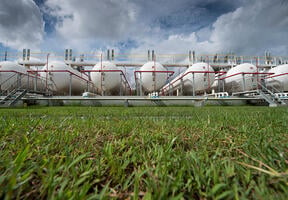
© Dufour Marco - Fuel storage tanks at the Feluy oil depot in Belgium.
Oil companies must deliver the right product to their many customers (gas stations, businesses, government agencies, individuals) at the right time, at the best possible price, and under optimal safety and environmental conditions. This is the goal of petroleum logistics, which relies on the existence of refineries, storage facilities, and a distribution network to transport petroleum products to consumers.
Oil depots: role and operation
In each country, there are only a small number of oil refineries, and some countries do not even have any. This is why there are depots where hydrocarbons are stored.
These intermediate storage centers enable a rapid response to local demand: they prevent companies from having to make multiple trips between refineries and product delivery points. In Europe, these storage facilities also house oil reserves known as strategic stocks, to cope with crisis situations or shortages.
What means of transport are used for petroleum products?
Petroleum products are transported from refineries to depots by means of bulk transportation: oil pipelines, tank trains, river barges, ships, etc. Each petroleum depot generally consists of between 10 and 30 steel tanks with capacities of 10,000 to 300,000 cubic meters for various petroleum products ( oil, gasoline, , kerosene). In France, there are around fifty main depots belonging to major petroleum operators or specialized storage companies.
Loading stations, of which there are up to a dozen in large depots, accommodate trucks with a capacity of 10 to 30 tons, some of which are compartmentalized so that they can transport several different types of products at the same time. They transport these products to smaller secondary depots managed by independent retailers or gas stations.
Safety measures in oil depots
Throughout the distribution chain, products are checked to ensure optimal quality. Petroleum products are hazardous goods associated with fire and explosion risks.
Distribution of safety is ensured by several measures (special permits for drivers of hazardous-materials tankers, periodic vehicle inspections).
Similarly, refineries and oil depots in Europe comply with the regulations set out in the Seveso Directive. This directive was established following an industrial accident in 1976 at a factory in the town of Seveso in Italy.
The administration strictly monitors the implementation of safety measures at sites. Oil depots must therefore have very detailed systems in place:
- Vents (devices similar to safety valves) are installed on each tank to prevent overpressure by allowing gases to escape if necessary.
- Floating screens are placed inside tanks containing gasoline. These are movable covers that rest directly on the liquid. Their role is to limit the evaporation of volatile products and thus the dispersion of vapors into the atmosphere.
- Alarms, hydrocarbon detectors, and automatic shut-off valves are installed on tanks and pipes to detect and stop any leaks.
- Fixed firefighting systems (sprinkler systems, water curtains) and mobile systems (water and foam cannons) are installed in storage facilities to extinguish any fires.
Measures to protect the environment
Specific measures can be implemented to prevent pollution. Each depot has several types of facilities, such as:
- A vapor recovery unit at truck loading stations.
- Retention basins installed around the tanks to recover any liquid that may leak.
- Containment basins to recover water used to wash equipment or rainwater that falls on the depot.
 This may interest you
See all