Nuclear Energy
5 min read
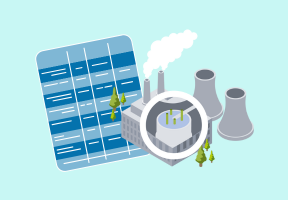
Nuclear plants harness the energy from to generate .
Nuclear energy originates in the very heart of matter, in the nuclei of atoms. We are going to split the nuclei of certain atoms: that is called nuclear fission.
The matter that undergoes nuclear fission is called . In concrete terms, it's a metal and also a mineral that is to say one of the constituent elements of rocks.
For nuclear fission, we can also use plutonium: the difference between uranium and this latter element being that it virtually doesn't exist on Earth in its natural state.
We can therefore think of plutonium as an artificial element. 7 grams of enriched uranium liberate as much energy as the combustion of 1 ton of an average oil or 1500 kilograms of !
In the reactor building, neutrons are going to collide with pastilles of uranium dioxide. The uranium is going to break down; that is nuclear fission, liberating other neutrons, which will in their turn collide with other nuclei; that is a chain reaction.
Nuclear fission gives out colossal quantities of energy in the form of . The heat is used to heat water in a primary circuit where the water reaches a temperature of around 300° Celsius.
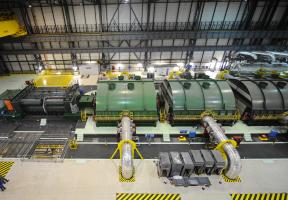
This hot water is used to heat water in a second circuit containing water at atmospheric pressure. The steam from the second circuit will be used to turn turbines coupled to turbo alternators.
We obtain electricity, which after having been raised to a high voltage (400000 volts) will be fed into the distribution network. A third circuit exists: the tertiary cooling circuit.
Water is taken from a natural milieu and made to circulate alongside the water of the secondary circuit after the turbine. The vapor, cooled and condensed, is re-injected in liquid form into the secondary circuit.
 This may interest you
See all