From Forests to Coal: A Slow Transformation
5 min read
At the end of the Paleozoic era, when the Earth’s climate was hot and humid, large forests were successively buried, resulting in the formation of over millennia. At different stages of development, it takes the form of peat, (brown coal), bituminous coal and finally . Today, coal is extracted from underground mines or, when it is close to the surface, open-pit mines. Coal is still the main source of energy used for generation worldwide.
From Forests to Coal A Slow Transformation
We are at the end of the primary era, the period called “Carboniferous”. The Earth is at that time like an enormous greenhouse: a hot and humid climate with luxuriant vegetation and enormous forests on the edges of seas and marshy zones.
Everything started with the burial of these forests. Then, progressively, these layers of vegetation accumulated and slowly changed into coal, sheltered from the air.
Different coals exist corresponding to different stages of the formation process. First, there is peat (which is quite a bad ), then lignite (or brown coal), followed by coal (or black coal), and finally anthracite (a very hard coal).
Two major methods are used today for coal extraction, depending on the geological configuration of the field and its surroundings.
If the thickness of earth covering the coal layers is not excessive, the field is exploited as an open cast mine. If the coal layers are very deep, they are exploited by excavating a network of underground galleries.
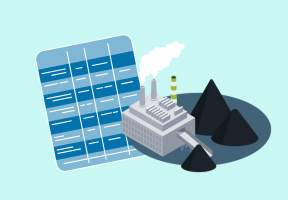
Coal is still the main energy worldwide for the production of in thermal power stations. By heating water, steam or calorific energy is obtained, that is transformed into and then into electric energy.
Is there a new future for coal that so marked the 19th Century? To be continued…
The use of coal for heating began various centuries before Christ, in China and then in Europe. But being buried, sometimes deeply, it would have to await the second half of the 18th Century before being extracted in massive quantities.
In the 19th Century, coal is largely used to drive steam machines, which are at the origin of the Industrial Revolution. That will allow industry and transport to change the face of the world.
With the steam locomotive, powered by coal, it's a transport network that is going to bring men closer together and make trade easier. The first factories are set up, leading to mass production.
But coal also becomes very rapidly a key energy source for the production of electricity. Even nowadays, coal remains the number one energy used worldwide to make electricity.
The use of coal varies today according to the region of the world. Available in major or minor quantities, depending on the country, the future of coal depends largely on our capacity to control the harmful effects that its exploitation still generates.
emissions are an example of the problem.
 This may interest you
See all