Growing nature into cities: how does it work?
7 min read
New York, Hong Kong, Copenhagen, Riyadh: almost everywhere in the world, people are trying to plant on urban surfaces. This may involve rooftop crops grown by a few city dwellers, robotic vertical farms, or large-scale urban planning to create urban islands and a more pleasant environment.
- Gwen Schantz, Brooklyn Grange Co-Founder and Chief Creative Officer
- Andrew Tsui, Co-Founder of Rooftop Republic
- Anders Riemann, CEO of Nordic Harvest
- Abdelaziz Al-Moqbel, director of "Green Riyadh" project
- Mohammed, Saudi living next to a green space area in Riyad
Across the globe, cities are going from grey to green Initiatives like urban farming or mass tree planting are spreading could these green spaces transform urban living?
New York, United States
Here on the 9th floor of a building complex in Brooklyn is one of the biggest rooftop farms in the world.
Gwen Schantz, Brooklyn Grange Co-Founder and Chief Creative Officer:
- "There were decades and decades of urban design where the goal was just to pave everything and keep everything very clean and cover it with concrete. And now we've learned that that's a problem. It doesn't work from a stormwater management standpoint. It doesn't work from a human wellness standpoint. So now we're basically taking this concrete canvas that we have, and we're adding soil back on top of it, we're adding plants to it and we're helping people to reconnect with nature because it really is important for our health. 45 tonnes of organic produce are grown each year on 22,000m² of roof space. My friends and I wanted to become farmers. But we wanted to live in the city and there weren't that many jobs like that. So, we had to start our own business in order to create these jobs. And we really wanted to have a farm just like every farm in the region. We wanted a small sustainable farm that operated as a business. The only difference is that we're in the city and we're on rooftops.
- Green roofs, like ours have a really positive impact on stormwater runoff and on our local waterways. We also cool and clean the air. Anytime you have plants and soil in a city, it helps to improve the air quality. There's also benefits of the green roof on the building below, we help to protect the rooftop, we also insulate the roof and the building from the sun and from the cold. There's a limit to how much weight and soil we can add to a roof like this. So, our soil is only about 12 inches deep. And that means that we can grow a wide variety of vegetables, but we have to irrigate the soil a little more frequently, because it dries out very quickly."
Hong Kong, China
Urban farming is catching on in cities across the world at 150m high, perched on the Bank of America Tower, this vertical farm is just one of 60 across Hong Kong.
Andrew Tsui, Co-Founder of Rooftop Republic:
- "We could have the potential of doubling the supply of space or rather land to grow food. What we are looking at is really how to identify underutilised or idling spaces among the city and mobilise the citizens, the people, to learn about food, to understand the story to re-establish the relationship – a very much broken relationship ever since we started outsourcing our food and relaying so much on the industrialised kind of production."
Taastrup, Denmark
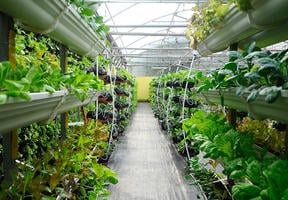
Crops can also be grown without sunlight or soil in a district of Copenhagen, 28,000 LED lamps provide the heat and light necessary to grow lettuces, herbs and kale.
Anders Riemann, CEO of Nordic Harvest:
- "We are proving that it's possible to move some of the agricultural production into the cities so the special thing about this facility that we are in now is that we can produce 250 times more on the same footprint compared to a traditional farmer and that's because we can harvest 15 times a year. The farm harvests 15 crops every year small robots deliver trays of seeds from aisle to aisle and farmers use a scissor lift to handle the crops. We need to find other methods to produce the food that is being more and more demanded by the growing population."
These ‘high tech’ farms consume a lot of energy and are more well-suited for colder climates.
Riyadh, Saudi Arabia
Far away from the cold however, this city is hoping to create a green oasis in the middle of the desert. The ‘Green Riyadh’ project plans on planting 7.5 million trees and creating 3,000 urban parks by 2030.
Abdelaziz Al-Moqbel, director of "Green Riyadh" project:
- "The direct impact of the Green Riyadh project is that it will help decrease the normal temperature by one or two degrees celsius. We will improve the quality of life which will improve the urban environment and reduce air and dust pollution. This will also increase the social interaction between people and improve their health. The reforestation project will cost 11 billion dollars and will use one million cubic metres of water a day the water used will be recycled via an underground irrigation network."
Mohammed, Saudi living next to a green space area in Riyad:
- "We are proud of what's happening and it is affecting us positively, whenever we see the trees, it makes us so happy. I am even taking a walk now, just because there are trees."
Chengdu, Sichuan, China
With 70% of greenhouse gases coming from urban areas, cities going green could be a necessary tool in fighting .
 City & Environment
See all