What Is Geothermal Energy?
5 min read
As you descend deeper into the subsoil and the Earth’s crust, underground rock and water become hotter. This is referred to as energy, and can be recovered at various depths and temperatures using a range of techniques. It represents a source that can heat – or cool – houses, apartment blocks, factories and farm buildings. If used to drive a turbine, the heat can also be converted into .

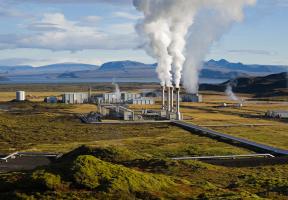
© AFP - Geysir, a natural source of steam in Iceland. The word geyser is derived from its name.
Groundwater and Aquifers
The adjective “geothermal” comes from the Greek words ge (earth) and thermos (heat). Underground heat is stored in shallow groundwater, and, deeper down, in aquifers – rock reservoirs in the Earth’s subsurface containing water – and granite rocks. About half this thermal energy comes from the residual heat produced when the planet was formed 4.5 billion years ago and the other half from natural .
Geothermal Gradient
The of each region measures the average rate at which the temperature rises with depth. In Europe, the average value of the gradient is 3°C per 100 meters of depth, or an increase of 30°C for 1,000 meters. This average depends on the physical conditions and geology of the region. For example, the temperatures in the subsurface of a volcanic area rise very quickly.
The Different Types of Geothermal Energy
Different types of geothermal energy require different technologies, depending on temperature, depth and how the heat is used.
There are three main categories:
- Very low-temperature geothermal energy. Harnessing temperatures under 30°C at depths between 10 and 200 meters, this type of energy is used to heat or cool single-family homes, apartment blocks or commercial buildings. The energy is recovered by pumping groundwater to the surface or by installing horizontal or vertical “geothermal borehole” systems in the ground. Heat pumps are used to raise the temperatures for heating or lower them for cooling.
- Deep low-temperature geothermal energy. Technologies in this category use water at temperatures between 30°C and 90°C collected at depths ranging from 200 to 2,500 meters. Water from aquifers is pumped up to the surface and then reinjected underground, using two wells forming a geothermal “doublet”. Connected to an aboveground heating system, this technique can be used to heat entire neighborhoods with thousands of inhabitants or industrial parks.
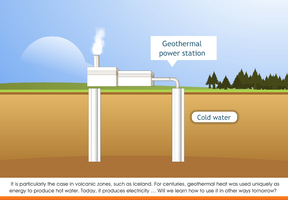
- High-temperature geothermal energy. Working with temperatures over 150°C, the main method used in this area is to draw on wells of steam far below the surface to produce electricity. Another technique involves injecting water into hot, dry rock deep underground, then recovering it back at the surface. High-temperature geothermal energy can also be used in to recover heat at the same time as generating .
In short:
| Temperature | Depth | Targets | Methods | |
|---|---|---|---|---|
| Very low-temperature geothermal energy | Less than 30% | Between 10 meters and 200 meters | Single-family homes, buildings, shopping malls | Horizontal networks, vertical boreholes, groundwater recovery (with or without a heat pump) |
| Deep low-temperature geothermal energy | Between 30°C and 90°C | Between 200 meters and 2,500 meters | Neighborhoods, industrial parks | Doublets (two vertical boreholes in aquifers) |
| High-temperature geothermal energy | More than 150°C | Between 1,500 meters and 5,000 meters | Power plants | Deep boreholes in aquifers, or of water into deep rock |
Advantages and Limitations of Geothermal Energy
Geothermal plants have the advantage of not taking up much space on the surface, not producing pollution and not making a lot of noise. They do not consume any water, instead reinjecting it back underground. And after the investment phase, operating costs are low.
However, geothermal reservoirs tend to deplete after 30 or 50 years of use. Deep boreholes need to be monitored to make sure they do not cause seismic movements. And at the surface, transporting heat over long distances entails significant losses, making it preferable to use the heat in the immediate vicinity or install a network to distribute it in the area.
An Educational Video on Geothermal Energy
 This may interest you
See all